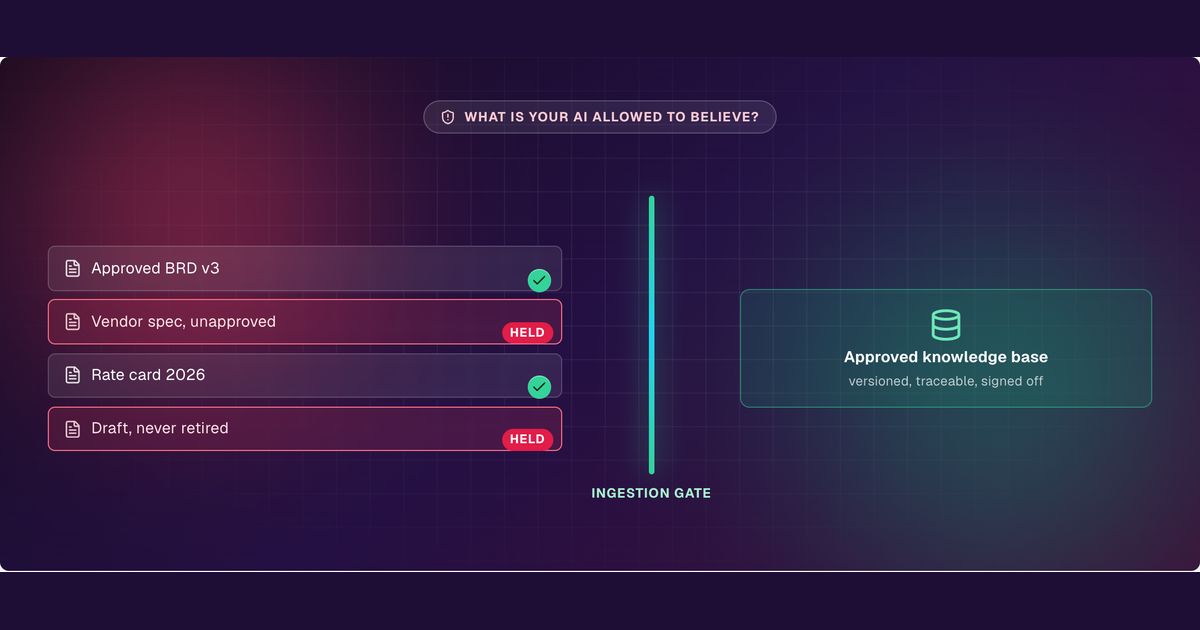
Responsible AI, Through the TRUST AI Framework
Responsible AI in industry is not an ethics poster on the wall. It is an architecture decision: governance, residency, model choice and cost, engineered in.
 6 min read
The four-minute shortcut
It is 11 p.m. The bid is due at noon. A bid manager pastes a 400-page RFP, the customer's drawings and last year's price book into a free AI chatbot and asks for a compliance summary.
Four minutes later, the summary is excellent. And the company's pricing logic, a named customer's specifications and three years of margin history now sit on a server nobody vetted, in a jurisdiction nobody chose, under terms nobody read.
No rule was broken, because no rule existed. That is how most AI risk enters an industrial enterprise: not through a hacker, but through a helpful employee. IBM's 2025 breach study found that shadow AI added about ₹1.79 crore to the average cost of a breach in India.
Responsible AI in industry is not an ethics poster on the wall. It is an architecture decision. That conviction is why we built tiramai on the TRUST AI framework.
As AI moves into mission-critical operations including factories, FinTech, engineering systems, transportation networks and healthcare environments, one question matters more than any other: can we trust AI not only to be intelligent, but to operate within the boundaries that matter? That is the real Responsible AI challenge for industry, and it has to be engineered into the architecture from day one. It cannot be a policy document added after an AI system is built.
Consumer AI is not industrial AI
Consumer AI is optimized for delight at scale. Industrial AI is optimized for being right, provably, when something is at stake. A wrong movie recommendation costs a click. A wrong clause in an EPC contract, a missed safety standard in an elevator bid or a mispriced HVAC tender cost crores, and sometimes more.
Model strategy matters more than most leaders realize. If your AI strategy is tied to one model provider, it expires the day that contract changes. Industrial enterprises plan assets on 20-year horizons; their AI cannot be hostage to a 12-month API agreement.
Your data is your moat, and your biggest liability
Foundation models are converging in capability and falling in price. Everyone can rent the same intelligence. What nobody can rent is your 20 years of won and lost bids, your field-failure history, your commissioning records and your customers' specifications. In industrial AI, the model is a commodity; the data is the moat.
That same data is also what regulators, customers and boards worry about most. Three pressures are converging.
- Residency. Government, defense, energy and BFSI customers increasingly specify where data is stored and processed. "Somewhere in the cloud" is no longer an acceptable answer in a tender questionnaire.
- Privacy. India's DPDP Rules, notified in November 2025, set a full-compliance deadline of 13 May 2027, with penalties of up to ₹250 crore per violation. Every AI pipeline that touches personal data becomes part of that compliance surface.
- Confidentiality. Pricing models, bid strategies and engineering IP are not personal data, so privacy law does not protect them. Only your architecture does.
Why AI stalls in regulated industries
Industrial leaders are not short of AI ambition. They are short of AI they can defend in front of an auditor. The numbers tell the same story from different angles.
Notice what is missing from Gartner's list of failure reasons: model capability. Projects are not dying because the AI is not smart enough. They die because nobody can answer the governance questions. In our conversations with industrial customers, five blockers come up again and again.
- Trust gap. Engineers will not act on an answer they cannot trace back to a source document.
- Residency ambiguity. Legal cannot sign off because nobody can say where prompts and embeddings are stored.
- Lock-in fear. Procurement hesitates to bet a multi-year programme on one model vendor's roadmap and pricing.
- Shadow AI. Teams move faster than policy, so sensitive data leaks through consumer tools.
- Cost opacity. Token-based bills that nobody can forecast make CFOs pause every expansion.
The TRUST AI framework
We did not design TRUST AI as a values statement. We designed it backwards, from the five objections that stall industrial AI programmes. Each pillar exists to remove one of them, and each comes with a question worth asking any AI vendor, including us.
- Policy-driven AI
- Evidence-backed answers
- Full audit trails
- Humans approve high-risk calls
Ask any AI vendor: Can you show me why the AI made this decision, and who approved it?
The first and last pillars share a letter for a reason. Trust is earned twice in an enterprise: once by the engineers who rely on the answer, and once by the CFO who pays for it.
An AI agent without governance is a business risk
A chatbot answers. An agent acts: it updates the ERP, sends the quotation, accepts the clause. The moment AI moves from advising to acting, governance stops being a compliance checkbox and becomes an operational control, as fundamental as a circuit breaker on a plant floor.
Our design rule is blunt: every critical AI decision should have a reason, a record and a responsible human. In practice, that means no agent executes anything without passing through explicit boundaries.
Four layers of control
Those boundaries rest on four layers of control, engineered into the platform rather than bolted around it.
- Encryption
- Tenant isolation
- RBAC and ABAC
- SSO and MFA
- Least privilege
- Policy guardrails
- Approval workflows
- Scoped agent permissions
- Bias and toxicity checks
- Drift and anomaly detection
- Hallucination checks
- Continuous evaluation
- Real-time alerts
- Automated fallbacks
- Model failover
- Backup
- Point-in-time recovery
- Disaster recovery
Explainability ties the four together. For any output, a reviewer should see the reasoning, the source data, the model and version that produced it, and where a human approved or overrode it. If you cannot reconstruct a decision six months later, you did not govern it; you just hoped.
Back to 11 p.m.
Replay the opening scene on a TRUST-built platform. The bid manager still gets the summary in four minutes. But the RFP never leaves the company's chosen region. The model is one the company selected, and could replace tomorrow. Every compliance finding links to the clause it came from. The unusual payment-security term is flagged and routed to the commercial head before anyone commits. And six months later, when an auditor asks how that bid was built, the answer is a log, not a shrug.
Same speed. Completely different risk profile. That is what Responsible AI looks like when it is engineered rather than declared.
The question for industrial leaders is no longer whether to adopt AI. It is whether the AI you adopt can be defended: to your regulator, your customer, your board and your own engineers.
If you are weighing that question for your organization, explore how TRUST AI works in the tiramai platform, or reach out to our team. We are always glad to compare notes with fellow practitioners.
Sources
- IBM: 2025 Cost of a Data Breach, India findings
- IBM: 2025 Cost of a Data Breach, AI oversight gap
- Gartner: over 40 percent of agentic AI projects expected to be cancelled by end-2027
- DPDP Act and Rules 2025: phased implementation timeline
- tiramai: Security, Governance and the TRUST AI framework
Working through this for your organisation? Our team can walk you through it on your own use case.
How tiramai runs governed AI in the cloud, your private cloud or fully on-premises.
Explore Agents Studio