The Overview Effect
Astronauts describe a shift in perspective when they see Earth from space: the boundaries disappear. Founders, I think, get their own version of it.
 4 min read
Recently, I heard astronaut Group Captain Shubhanshu Shukla speak about something that stayed with me long after the conversation ended: the Overview Effect.
Astronauts use the term to describe the profound shift in perspective that can happen when they see Earth from space. From there, the boundaries that seem so important to us disappear. Countries, states and cities are no longer visible as separate worlds. There is just one Earth.
Shukla explained this beautifully through the way our identity expands as we move through life.
Every horizon still contains the one below it.
From space, you do not look for a particular country, region or city. You look at the planet and think: this is where I live.
That thought made me reflect on my own professional journey. Not because I have travelled to space, but because becoming a founder has changed my perspective in a surprisingly similar way.
For many years, I had a role
I have spent more than 25 years working across aerospace, banking, payments and technology. Like most professionals, at every stage there was a role: engineering, quality, product, compliance, business, marketing and revenue. And with every role came a boundary.
When you lead engineering, you naturally look at the world through engineering. When you lead quality, you think deeply about quality. When you lead product, the product occupies your mind. When you lead revenue, customers, pipeline and numbers become the lens through which you see the business.
There is nothing wrong with this. In fact, organisations need specialists who care deeply about their areas of responsibility. But a role also gives you a certain altitude. You see the organisation from where you are standing.
Then I became a founder
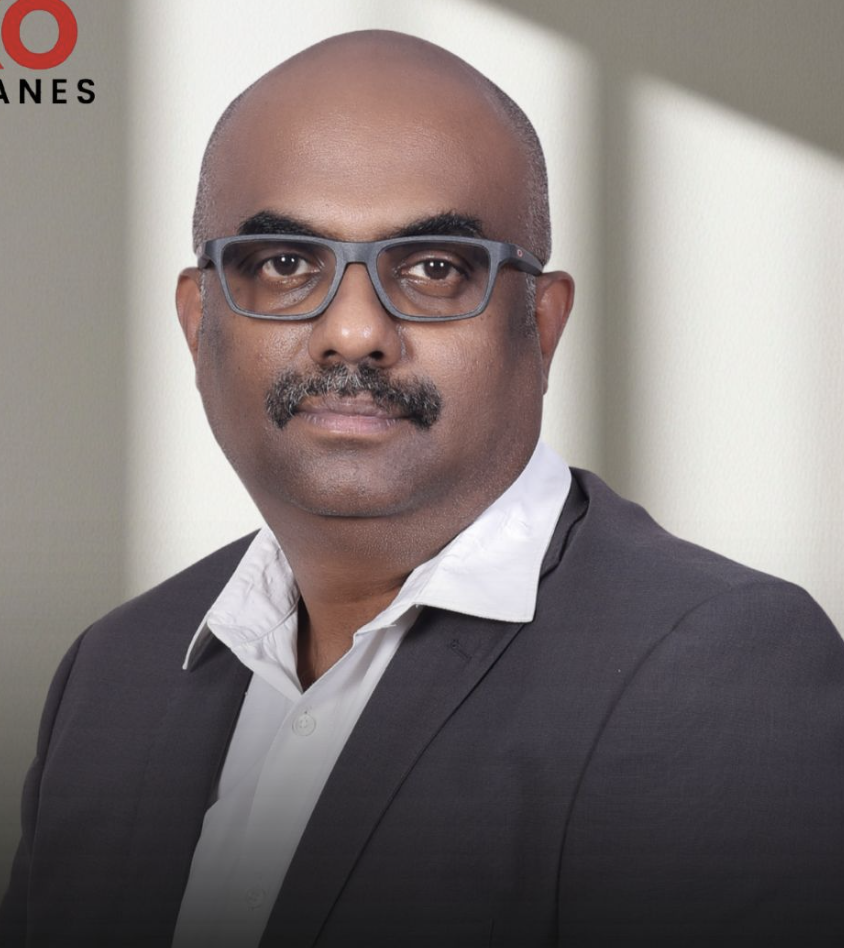
At tiramai, my title says Co-Founder and Chief Marketing and Revenue Officer. But increasingly, I have realised that founder and role do not fit comfortably in the same sentence. Because when you are building a company, the boundaries begin to disappear.
It is simply that I can no longer look at the company only through the boundary of my function. That boundary has disappeared.
Perhaps founders experience their own Overview Effect
When you work inside a large organisation, it is natural to see the world from the perspective of your function. You ask: what is my responsibility? What is my team’s responsibility? Who owns this? Building a startup has slowly changed those questions for me.
“What is my responsibility, and who owns this?”
The beam covers one column. Everything outside it belongs to someone else.“What does the company need right now?”
The beam covers the floor. The answer changes weekly, and rarely respects the chart.Sometimes the answer is sales. Sometimes it is product. Sometimes it is pricing. Sometimes it is sitting with a customer and understanding a problem that has nothing to do with the agenda you walked in with. Sometimes it is rewriting a slide at midnight because the story is not good enough. Sometimes it is challenging the product team. And sometimes it is the product team challenging you, because what the market appears to want is not necessarily what it needs.
The altitude changes your perspective.
From function to outcome
Perhaps that has been one of my biggest lessons in building tiramai. Earlier in my career, I thought increasingly senior roles meant increasingly larger responsibilities. Today, I see it slightly differently.
Leadership is not only about the size of your responsibility. It is about the breadth of your perspective.
Marketing cannot succeed if the product does not deliver. Product cannot succeed if it does not solve a problem somebody will pay to solve. Engineering cannot be separated from customer experience. Revenue cannot be separated from trust. Strategy cannot be separated from execution. And none of them matter for very long if the customer does not see value.
The role gets bigger. The ego should get smaller.
There is another part of the Overview Effect that I find particularly powerful: the recognition of scale, and of how small each of us is within it. There is a lesson for founders there too. As your responsibility expands, it is tempting for your sense of importance to expand with it. Perhaps the opposite should happen.
A founder cannot write every line of code, make every sale, solve every customer problem or make every decision. The job is not to become the centre of the organisation. It is to help the organisation succeed as a whole. That requires ownership. But it also requires humility.
My definition of "my role" has changed
If you had asked me earlier in my career what my role was, I could probably have answered with a job description. Today, my answer would be much simpler.
My role is whatever tiramai needs from me to move forward.
That does not mean roles do not matter. They do. Accountability matters. Expertise matters. Structure matters. But ownership has to be larger than the organisation chart.
Perhaps that is the founder’s version of the Overview Effect. You start your career looking at your desk. Then your team. Then your function. Then your business. And one day, when you are building something of your own, you look down and realise: the whole company is home.
And once you see it that way, it is difficult to see your role the same way again.
If that is how you like to work, we are building tiramai in Bangalore, and we are hiring.
Working through this for your organisation? Our team can walk you through it on your own use case.
How tiramai runs governed AI in the cloud, your private cloud or fully on-premises.
Platform overview